Callouts vs. Pull Quotes: Two Small Design Details That Can Make a Big Difference
Well-placed pull quotes and callouts create visual stopping points that can communicate your strongest ideas at a glance.
A well-designed nonfiction book isn't just about what you write. How your words appear on the page can influence what readers notice, remember, and take away from the book.
Two design elements authors often encounter are callouts and pull quotes. They may look similar at first glance, but they serve different purposes. Understanding the difference—and knowing when to use each—can help you create a book that feels engaging without becoming visually cluttered.
What Is a Pull Quote?
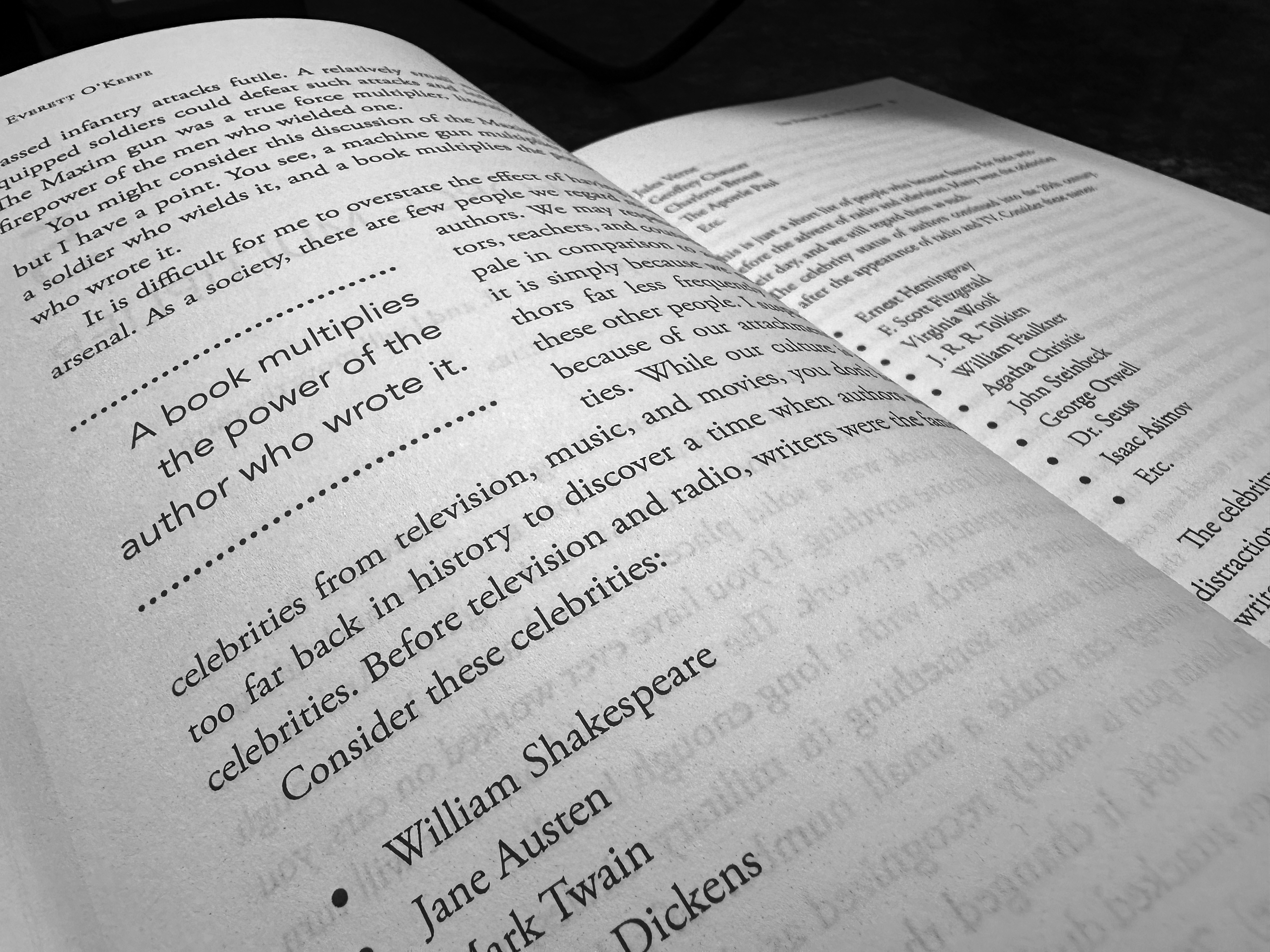
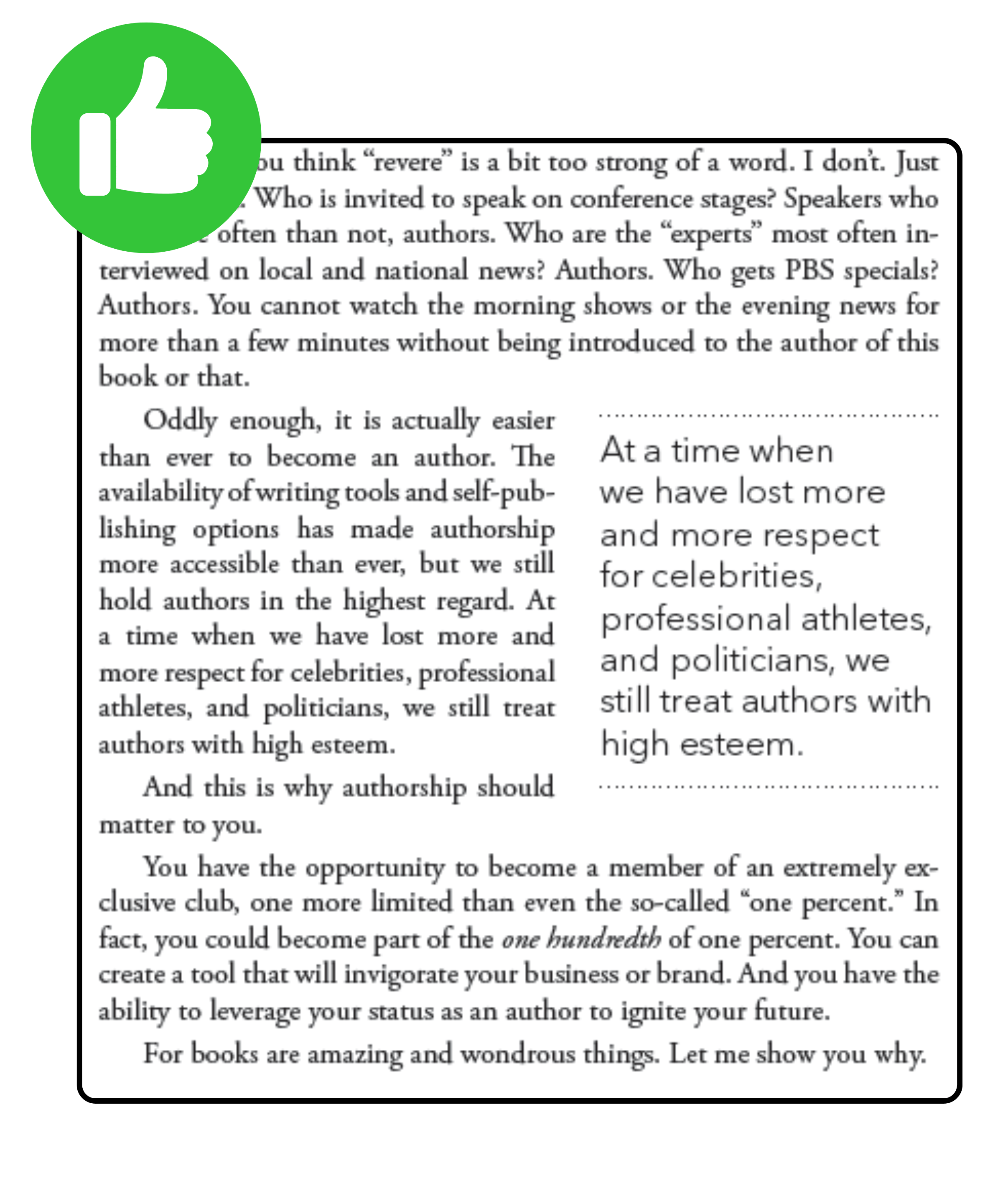
Flip open almost any well-designed nonfiction book and you'll likely see one: a line of text set larger than the surrounding body copy, perhaps inside a box or framed by thin rules. The sentence also appears somewhere else on the page as part of the regular text.
That's a pull quote.
A pull quote takes a phrase or sentence directly from your manuscript and repeats it elsewhere on the page for emphasis. It's not new content. Instead, it's an echo of something you've already written, designed to catch the reader's eye.
Think of it as a highlight reel of your book's most memorable ideas.
What is a Callout?
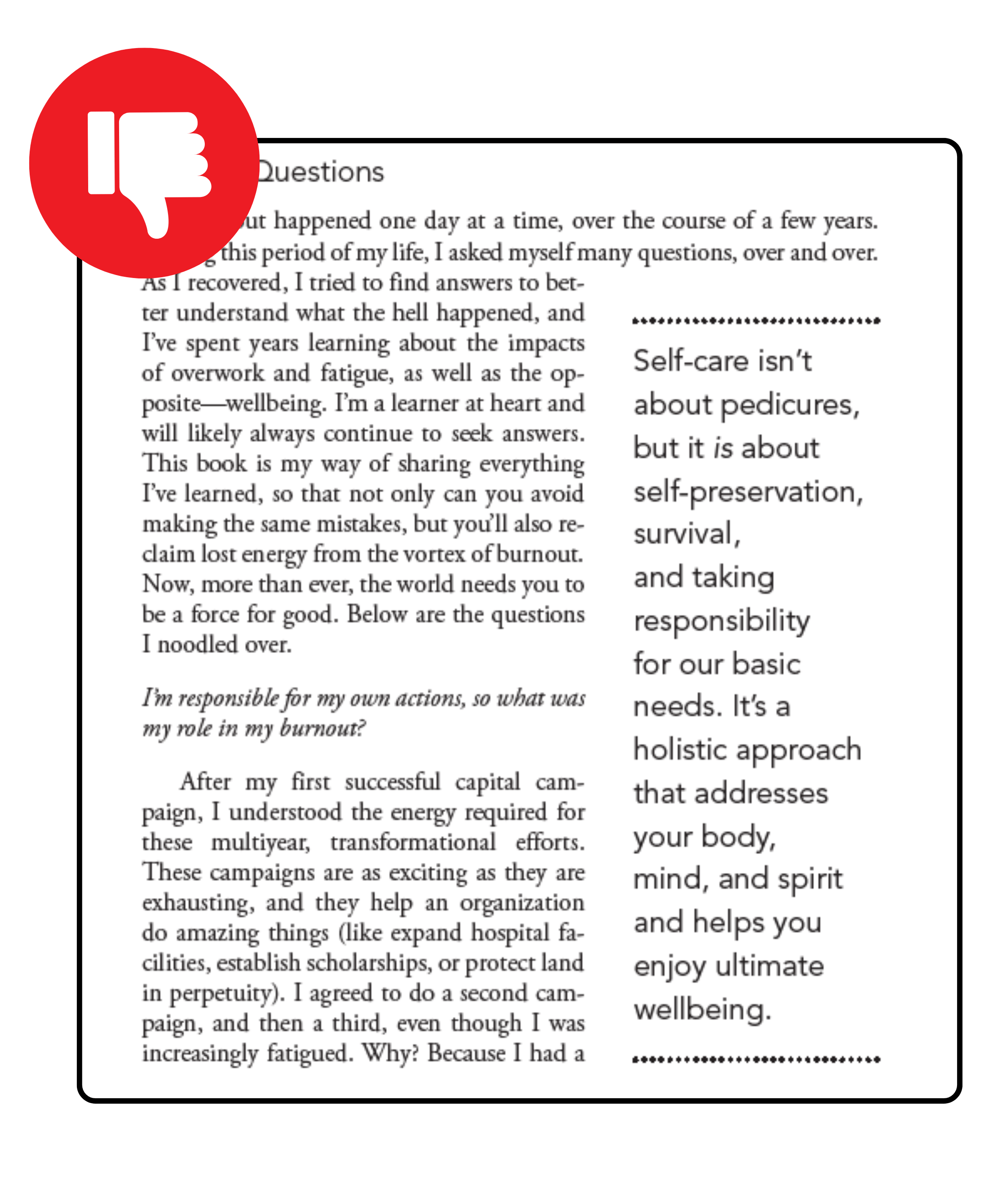
Whereas pull quotes duplicate words from the body of the text, callouts expand upon the text. While they are often set apart much like a pull quote, callouts are really self-contained mini sections. These can be used to display various elements:
A definition of a term.
Quick tips, key takeaways, or action items.
Comments or discussions that you would like included but that would take away from the flow of the book if kept in the body of the text.
Other Elements
Pull quotes are sometimes confused with other types of book content, but there are important differences:
An epigraph is a quotation, typically from another person, placed at the beginning of a chapter or book.
A block quote is a longer quotation that is visually separated from the surrounding text, typically for length and sourcing purposes. This is often formatted with a block indent and/or italics.
While the treatments can look similar, their purposes aren't necessarily the same.
Why Pull Quotes and Callouts Matter
Both elements can give readers a way into your book, particularly when they're skimming.
Readers often flip through a nonfiction book before deciding whether to read it. They might browse it in a bookstore, look through the pages on Amazon, or quickly scan a copy someone handed them.
Well-placed pull quotes and callouts create visual stopping points that can communicate your strongest ideas at a glance.
They can also:
Break up dense pages of text
Give readers a visual place to pause
Reinforce important concepts
Highlight memorable or surprising ideas
Help readers quickly understand the book's central messages
Give your book a more engaging visual rhythm
So, What's the Difference?
The easiest way to think about it is this:
A pull quote repeats. A callout expands.
A pull quote takes text from the manuscript and repeats it elsewhere on the page in a visually prominent way.
A callout also draws attention to an important idea, but the emphasis is on selecting a particularly strong piece of content for special treatment. Callouts can be a powerful takeaway, memorable statement, surprising statistic, concise piece of advice, key concept, or strong quote.
In practice, the two can sometimes look very similar on the finished page. What matters most is understanding what you want the element to accomplish and communicating that clearly to your layout team.
How to Choose the Right Content
Whether you're selecting a pull quote or a callout, resist the temptation to highlight everything.
The strongest choices are passages that stand on their own.
Ask yourself:
Would this make sense without the surrounding paragraph?
Is this one of the strongest ideas in the section?
Would a reader remember it?
Does it offer a useful takeaway?
Does it make someone want to keep reading?
For pull quotes especially, avoid choosing a sentence that only makes sense because of the paragraph surrounding it. The best pull quotes can stand on their own and make an impact even when a reader encounters them while skimming.
Keep It Short
Shorter is almost always stronger.
For callouts, Ignite Press recommends one or two short sentences maximum and 150 characters or less. The purpose is to emphasize the idea, not compete with the main text.
The same principle works well for pull quotes. If you've selected an entire paragraph, there's probably a stronger sentence hiding inside it.
Don't Overdo It
One of the easiest ways to diminish the impact of these elements is to use too many.
Callouts should generally appear no more than once every three to four pages, and they should not appear on consecutive pages. Not every chapter or section needs one.
The same philosophy applies to pull quotes. If every page has something competing for the reader's attention, nothing feels particularly important.
Remember: the goal is emphasis, not decoration.
Pull quotes can be particularly effective at one or two key moments per chapter, depending on the chapter's length and design. And if your book already contains photographs, illustrations, charts, bullet lists, or other visual elements, adding more may create unnecessary clutter.
When in doubt, ask your publisher or layout team for guidance.
Think Beyond the Book
There's another advantage to choosing strong, memorable lines: they can have a life outside the book.
A great pull quote can become a social media graphic, a LinkedIn post, an email marketing element, or part of your book launch content.
In other words, the right sentence can work twice:
First on the page. Then in your marketing.
Before selecting a pull quote, ask yourself whether you'd want to share that sentence as a standalone graphic. If the answer is yes, you've probably found a strong candidate.
How to Mark Your Callouts for Layout
Once you've chosen a callout, make sure your manuscript clearly communicates what you want the layout team to do.
STEP 1: Highlight the exact text or sentences you want featured.
STEP 2: Add a comment to the highlighted text that says, "LAYOUT: CALLOUT"
This lets the layout team know that the highlighted passage should receive special visual treatment.
What If You Want Different Wording?
If the wording you want displayed doesn't exactly match the text in your manuscript, be specific.
For example: "LAYOUT: Make the following a callout: “Your strongest ideas deserve to be remembered.'”
Clearly identifying the exact wording prevents confusion during layout.
The Bottom Line
Pull quotes and callouts are small design choices, but they can have a meaningful effect on how readers experience your book.
Use them to draw attention to your strongest ideas, break up dense pages, and give skimming readers a reason to stop and engage.
Just remember:
Choose the strongest content. Keep it short. Give it room to breathe. And don't use it everywhere.
The best-designed books don't try to make every sentence stand out. They know which sentences deserve to.